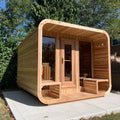
How to Size a Sauna Heater
If your sauna ships as a cabin with the heater sold separately, this is the first thing you have to get right. Too small and it never reaches temperature. Too large and you have paid an electrician for a circuit you did not need.
It is not complicated. It takes about two minutes and a tape measure.
The short version: work out your sauna's interior volume in cubic feet, add some for glass, then allow roughly 1 kW for every 45 cubic feet. Most home saunas land between 3 and 8 kW.
Step 1 — Find the interior volume
Measure the inside of the sauna, not the outside. Width × depth × height, in inches, divided by 1,728.
A cabin measuring 55.5" wide, 59.1" deep and 76" high:
249,284 ÷ 1728 = 144 cubic feet
For a barrel sauna, use the cylinder formula — π × radius² × length — and then take off a little, because the flat floor cuts the bottom off the cylinder. Close enough is genuinely close enough here.
Step 2 — Add for glass
This is the step people skip, and it is the one that matters most on a modern sauna.
Glass sheds heat far faster than an insulated wood panel. A cabin with a full-glass front wall behaves, thermally, like a considerably larger room. The standard allowance is to add about 1.25 cubic feet of effective volume for every square foot of glass.
So a sauna with 27 square feet of glass gains roughly 34 cubic feet of effective volume — which on a 144 cubic foot cabin is a jump of nearly a quarter.
Apply the same logic to any other uninsulated surface: stone, tile, concrete or an uninsulated exterior wall.
Step 3 — Apply the rule
Taking the worked example through: 144 cubic feet, plus 34 for glass, is 178 effective cubic feet. Divided by 45, that is about 4 kW — so a heater in the 4 to 6 kW band.
Round up rather than down, and round up further if:
- The sauna is outdoors in a cold climate
- You want it ready quickly rather than in an hour
- There is a lot of stone, tile or concrete inside
- It is a large glass front rather than just a glass door
The numbers for the saunas we sell
Every one of these ships as the cabin with the heater bought separately, so we have done the arithmetic for you. The volumes come from each manufacturer's published interior dimensions — check them yourself with the formula above.
| Sauna | Interior volume | Working range |
|---|---|---|
| SaunaLife CL3G | About 93 cu ft | 3–4.5 kW |
| SaunaLife GL4 | About 144 cu ft | 4–6 kW |
| SaunaLife E7 barrel | About 145 cu ft | 4.5–6 kW |
| SaunaLife CL5G | About 184 cu ft | 6–8 kW |
These ranges are ours, applying the standard rule to the manufacturer's published dimensions. They are not the manufacturer's own recommendation, and the installation manual governs. We show the arithmetic so you can check it rather than take it on trust.
Wood-fired is sized differently
Wood stoves are not rated in kW. They are rated by the room volume they are built to heat, usually given as a range in cubic feet or cubic metres.
So the work in Steps 1 and 2 still applies — you just match your cubic feet to the stove's stated range instead of dividing by 45. A stove rated for 140–210 cubic feet suits a 144 cubic foot cabin comfortably.
Two things the kW calculation does not tell you about wood:
- A wood stove takes up floor space, and inside a small cabin that is a meaningful share of the room
- It needs a flue, correct clearances, and dry storage — none of which a kW figure captures
What goes wrong in each direction
| What you notice | |
|---|---|
| Undersized | Never quite reaches temperature. Runs flat out and still disappoints, especially in winter. Costs more to run, not less, because it never gets to cycle off. |
| Oversized | Reaches temperature then cycles hard, so the heat feels harsh and uneven rather than steady. You have also paid for a heavier circuit than the room needed. |
Of the two, undersized is the worse mistake, because the only fix is a new heater. That is why you round up.
The electrical side — do not estimate this one
Sizing a heater and specifying its circuit are two different jobs, and only one of them is arithmetic.
The voltage, amperage and breaker size come from the heater's own rating label and manual. Do not work them backwards from a kW figure, and do not have an electrician run a circuit to a number you calculated. Most saunas above roughly 4.5 kW need a dedicated 240V circuit; below that some run on 120V. But “most” is not a spec.
Buy the heater, read its label, then book the electrician.
Common questions
Why 45 cubic feet per kW and not some other number?
It is the long-standing rule of thumb across the industry, and it assumes an insulated wood sauna reaching 160–200°F in about an hour. You will see 50 cubic feet quoted too. The difference between the two is small enough that it rarely changes which heater you buy — and where it does, round up.
Does the rule work for infrared saunas?
No. Infrared saunas warm your body directly with radiant panels rather than heating the air, and they run cooler — around 120–150°F. They come with their panels built in and sized by the manufacturer, so there is nothing for you to calculate. This guide is for traditional stove-and-rock saunas.
My sauna has a huge glass front. How much do I add?
Measure the glass area in square feet and add 1.25 cubic feet of effective volume per square foot. If the whole front wall is glass and you are between two heater sizes, take the larger one — a big glass panel loses more heat than the rule fully accounts for, especially outdoors in winter.
Can I use a bigger heater and just turn it down?
Up to a point. A modestly oversized heater is not a problem. A heavily oversized one cycles on and off hard, which makes the heat feel harsh rather than even, and it needs a bigger circuit, which costs real money at installation.
How many stones does it need?
The heater's manual states its stone capacity, and it is worth filling to that figure. Stones are what hold heat and give you steam when you pour — an underfilled heater gives thin, short-lived steam. Stones are also cheap compared with everything else in the project.
Can you just tell me which heater to buy?
Yes. Call 866-427-8202 with your sauna model, or the interior measurements if it is not one of ours, and we will work it through with you. If it is a sauna we sell, we will confirm the figure against the manufacturer's manual before you order anything.
Still not sure?
Call 866-427-8202. Tell us the model or the interior measurements and whether you are leaning electric or wood-fired, and we will give you a straight answer. It is a five-minute conversation and it is considerably cheaper than a heater that does not suit the room.